 English
 Русский

Key Takeaways: Your 30-Day Compliance Recovery
- The Warning: The “Letters of Concern” from the Ministry of Economy & Tourism (MoET) is now in the active enforcement phase by issuing to address specific deficiencies in Anti-Money Laundering (AML) systems.
- The Due Date: You have exactly a strict 30-day deadline, counted from the day you received the email, to implement and prove your “Immediate Enhancements”.
- The Legal & Guidance References: The Federal Decree-Law No. 10 of 2025 and other relevant rules and regulations are the new legal bases; your policy should be aligned with them.
- The Risk: If you ignore this Letter of Concern, expect to be slapped with AED 50,000 to AED 5,000,000 penalties.
Is Your Company on a 30-Day Countdown?
Picture this: you start your day by checking your corporate inbox to find a letter of concern from MoET. This puts your trade license on a 30-day countdown. For many Real Estate agencies, Law firms, and Corporate Service Providers (CSPs) in the UAE, this is no longer a “what if” scenario—it is a reality of active enforcement.
Many business owners treat Anti-Money Laundering (AML) as a “check-the-box” exercise. However, with the large number of distributed “Letters of Concern,” the Ministry is sending a clear message: compliance must be taken seriously. When you receive this letter of concern, you must submit an officially approved declaration signed by senior management or shareholders committing to corrective measures, and you typically have just one month to implement them and submit evidence.
The Legal Blueprint: Your Compliance Compass
To resolve a Letter of Concern, your remediation plan must be strictly aligned with the current UAE regulatory framework. Your policy and evidence must reference these specific Legal and Guidance References:
- Federal Decree-Law No. 10 of 2025 regarding AML, CFT, and Proliferation Financing.
- Cabinet Decision No. 134 of 2025 on the Executive Regulations of the 2025 Decree-Law.
- Cabinet Resolution No. 71 of 2024 regarding violations and Administrative Penalties.
- Cabinet Resolution No. 74 of 2020 regarding Local Terrorist Lists and UN Security Council resolutions.
- National Guidance: All relevant guidelines, circulars, and controls issued by the MoET and the Executive Office for Control and Non-Proliferation (EOCN).
What is an MoET Letter of Concern?
A Letter of Concern is a formal administrative alert from the Ministry of Economy & Tourism (MoET) directed at Designated Non-Financial Businesses and Professions (DNFBPs). It serves as an official notice that, following either a remote review or an on-site field audit, the Ministry has flagged specific gaps or “deficiencies” in your current Anti-Money Laundering (AML), Counter-Terrorism Financing (CFT), and Proliferation Financing (PF) frameworks.
If you receive this email, it doesn’t mean you are fined; however, this puts your business in a very critical position. If you do not act on the remediation plan outlined in the letter, you will receive severe administrative and financial penalties under Cabinet Resolution No. 71 of 2024.
Three Massive Changes Since Your Last AML Audit
Since our previous AML Compliance Guide, the UAE’s regulatory landscape has changed significantly. To understand why you might have received a notice, you must look at these three major changes:
1. The Transition to Federal Decree-Law No. 10 of 2025
The major overhaul follows the introduction of Federal Decree-Law No. 10 of 2025. This law repealed Federal Decree-Law No. 20 of 2018 and provided the Ministry of Economy & Tourism (MoET) with sharper auditing tools.
2. UAE Landscape After the Removal from the FATF Grey List
In February 2024, the Financial Action Task Force (FATF) officially removed the UAE from its “Grey List” or jurisdictions under increased monitoring. To ensure the country is not listed as such again, the MoE has significantly increased the frequency of inspections and tightened audit criteria. The Ministry is working double time to demonstrate the UAE’s commitment to full compliance by enforcing “Effective Supervision”.
3. The Mandatory Inclusion of Proliferation Financing (PF)
Compliance has evolved from AML/CFT to AML/CFT/CPF. DNFBPs are now required to include risk measures against Proliferation Financing in their compliance manuals. Most “Letters of Concern” are triggered because a company’s manual failed to include these specific CPF controls mandated by the 2025 legislation.
Common Deficiencies: Why Companies are Getting Flagged
Based on recent MoE enforcement actions, DNFBPs commonly fail their off-site reviews due to a few critical blind spots. The Ministry isn’t looking for “perfection”; it expects DNFBPs to be “proactive”.
Here are some of the deficiency areas that are subject to a letter of concern:
- Referencing to Repealed Laws: Continuing to reference 2018 versions in your manual is an immediate deficiency.
- Using General Template: MoET expects manuals tailored to your specific sector’s unique threats.
- Missing or Unqualified MLRO: Appointing a Money Laundering Reporting Officer is mandatory; failure to do so is a severe breach.
- Sanctions Screening Failures: You must prove daily screenings against the United Nations (UN) Consolidated List and the UAE Local Terrorist List via the Executive Office for Control and Non-Proliferation (EOCN) website.
- goAML and Reporting Blind Spots: Lacking active goAML registration, failing to document industry-specific “red flags,” and failing to train staff on how to file Suspicious Transaction Reports (STRs).
- Missing Training Logs: Failure to provide attendance logs and training materials for periodic Targeted Financial Sanctions (TFS) during inspection.
Understanding the UAE’s AML Penalty Framework
Non-compliance with AML/CFT/CPF requirements in the UAE is a very serious matter and carries legal and financial risk. Cabinet Resolution No. 71 of 2024 establishes a unified, stringent penalty schedule for violations.
The shift toward “Objective Liability” means that the burden of proof has moved; the authorities now hold company leadership directly responsible for the health of their compliance systems. Non-compliance can result to:
- Heavy Corporate Fines: Between AED 500,000 and AED 50 million for critical breaches.
- Executive Accountability: Personal fines for senior management between AED 100,000 and AED 5 million.
- Per-Violation Fines: Fines are applied separately for every system failure found.
- Automatic Doubling of Fines: Unresolved infractions result in the Ministry doubling the penalty.
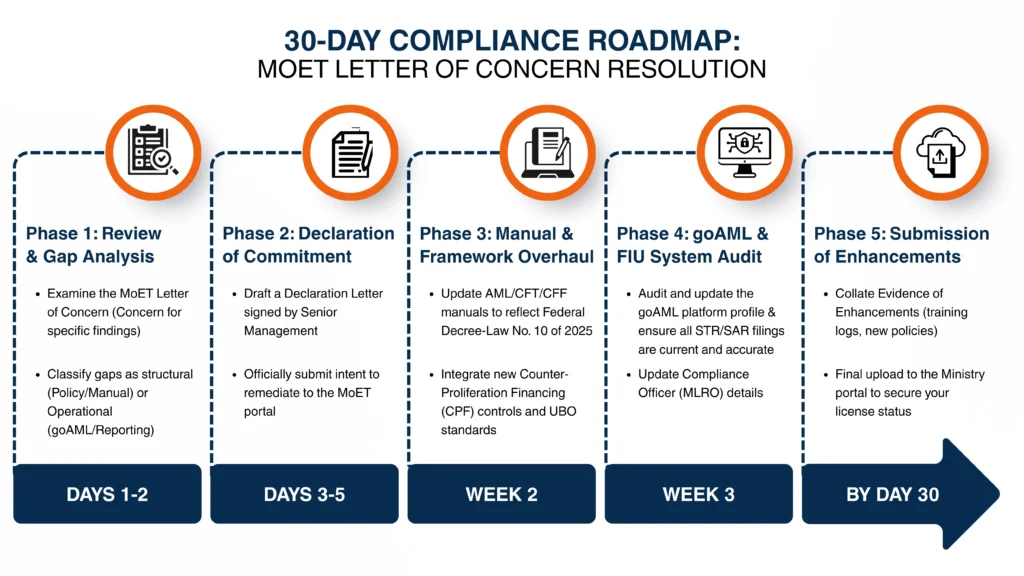
How to Resolve Your Letter of Concern in 30 Days
These are the steps to address the Letter of Concern within 30 days.
- Analyze the Findings: First, categorize the deficiencies listed as either Structural (outdated manuals) or Operational (reporting failures).
- Commitment Letter: Submit an officially approved declaration committing to corrective actions.
- Revisit your Internal Framework: Align your internal policies with the new 2025 standards.
- Fix Your goAML Profile: Ensure your FIU profile is accurate, and all reports are up to date.
- Submit Evidence of Improvement: Upload your new policies and training logs to the portal before the deadline.
Conclusion: Why Compliance Is No Longer Optional
The MoET has made it clear: the 30-day window is a strict deadline, not a suggestion. At CorpLex, we ensure your business is not just compliant on paper but shielded in practice.
Don’t Leave Your License to Chance
Don’t wait until Day 29. Reach out to our team today for a private evaluation of the remedial plans.
Compliance Questions You Might Be Missing
Is it possible to get an extension of the 30-day deadline?
No. The Ministry of Economy treats this period as a strict statutory window for corrective action. Missing this timeline will trigger the MoE’s action from “notifying” to the active imposition of fines.
Can the business owner also act as the Compliance Officer (MLRO)?
Yes, but with caution. While permitted in very small firms, the role must remain independent from revenue-generating activities to avoid conflicts of interest. You must be able to prove the MLRO has the authority to challenge senior management decisions.
Does the Ministry only audit large companies with high turnovers?
No. The MoE acts as the Supervisory Authority for all DNFBPs, including small real estate agencies and independent law firms. Regulatory intensity is based on risk, not just company size.
Can I get rid of my AML files if I close the business or go into liquidation?
No. Even if a company is dissolved, the law is very strict about the audit trail. As required by applicable laws, recordkeeping and retention should be maintained for at least 5 years after the business officially ceases to exist, ensuring that law enforcement can still access them if needed.
Does “Proliferation Financing” only apply to companies dealing in chemicals or weapons?
No. This is a common misconception. Under the 2025 Law, every DNFBP must include PF controls in its manual to prevent funds from being used to support weapons of mass destruction.